A teaching report · Fall 2026
The MATCHA writing lab
Reflections on running a supervised writing lab for 150 students in my Introduction to the Philosophy of Mind course at Western University.
Why a writing lab?
I want essays to remain a meaningful part of my teaching. That requires confidence that students are doing the thinking and writing themselves.
A supervised MATCHA lab addresses this problem by combining control over the writing process with supervision of the environment in which it takes place. Students can write their essays only while checked in, and a proctor is present to enforce the rules on other devices and outside materials. Together, these measures close off opportunities for AI misuse that are much harder to control at home.
This is why I regard the lab as the most reliable way to preserve essays as assessments of students’ own work.
How it works
This fall, I used the lab for three essays in my Introduction to the Philosophy of Mind course, which has 150 students. The same students also completed one essay at home using MATCHA.
Opening hours vary from week to week depending on how close we are to the submission deadline. The light schedule provides 20 hours, the medium schedule 32 hours, and the full schedule 48 hours. Students attend when it suits them and bring their own laptops with MATCHA Writer installed.
When a student arrives, the proctor checks them in so they can begin writing. They check out with the proctor before leaving. MATCHA disables essay writing whenever they are checked out, so they must return to the lab to continue the assignment.
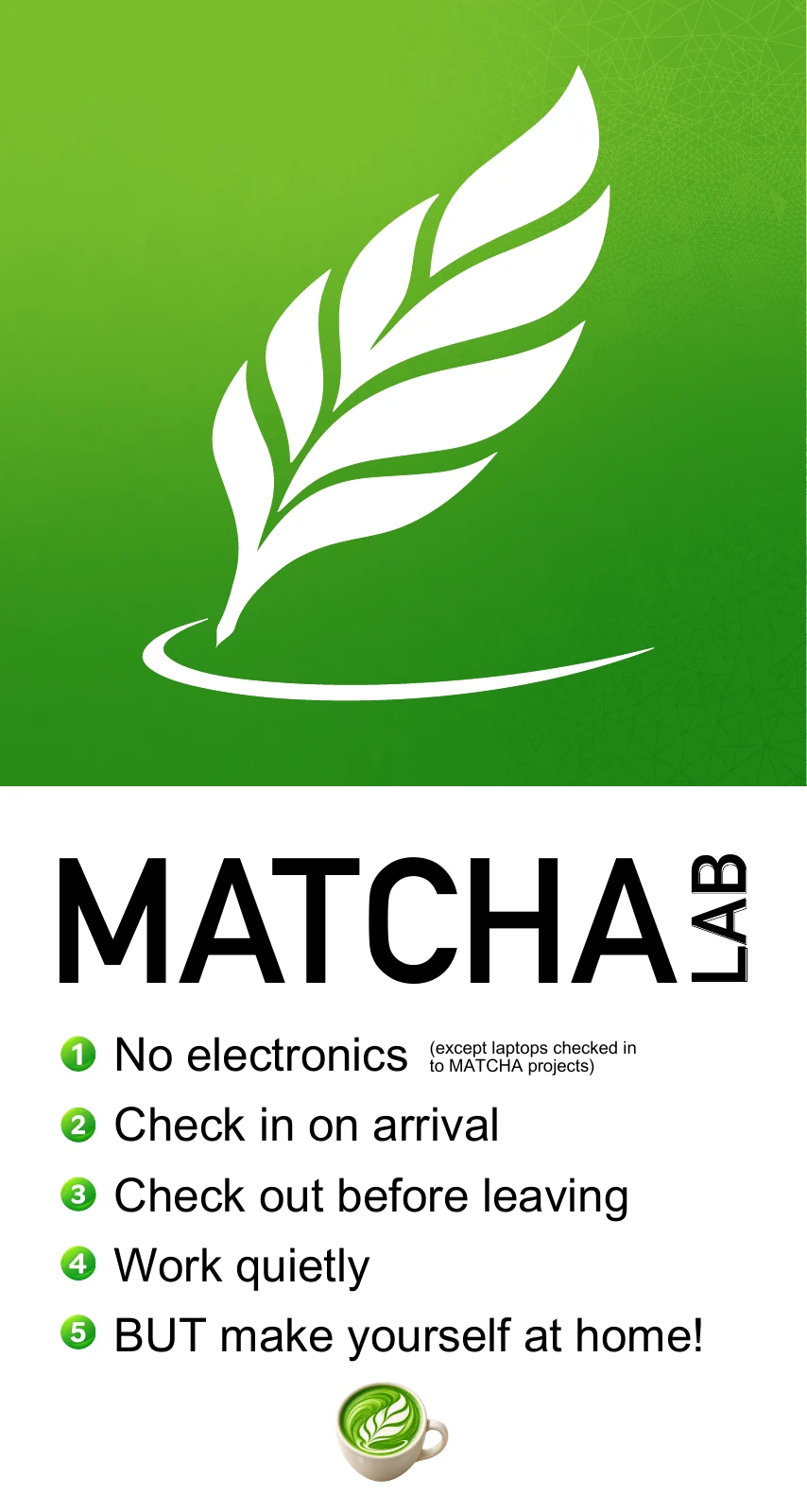
The poster I made to explain the lab guidelines. Anyone is welcome to use or modify it.
Open full-size PDF (18.5 MB)Reading at home
Because MATCHA also documents students’ reading, I had to decide whether to require them to read in the lab as well. I chose to allow reading at home. Requiring students to come to the lab simply to read seemed an unnecessary inconvenience.
This initially meant that students could read at home but could not take notes in MATCHA as they did so. After a few students raised this difficulty, we enabled annotations while students are checked out. We limit the length of these annotations, and MATCHA includes them in the final report. The limit is intended to allow brief notes on a reading without creating a way to bring an externally written essay into the lab.
The experience so far
Genuine student work
The essays are genuine. I can read and assess them with confidence that the thinking and writing are the students’ own. That is the central benefit of the lab.
A social side to writing
I’ve also seen students come to the lab with friends. It seems to be becoming a social experience as well as a place to work, which is an encouraging development.
The challenges
Staffing and scheduling
Staffing has been the main challenge. My initial plan was for teaching assistants to supervise the lab while carrying out other duties. That proposal met with resistance, and I eventually recruited an additional TA.
Without that extra support, I would have had to limit the lab to two essays and offer fewer hours each week. Scheduling remained demanding even with enough staff. It took several rounds of revision to find an arrangement that accommodated all five TAs.
Avoiding crunch time
I was initially concerned that all 150 students might turn up on the day an essay was due. The room has only 60 seats, so a rush near the deadline could have been difficult to accommodate.
In practice, this has not been a problem. The room has never been anywhere near full. I suspect that the automatic extension of 72 hours I give students helps spread demand. Some are comfortable working up to the final cutoff, while others keep to the nominal deadline. Many also submit well in advance.
Adjusting to a different way of working
The lab also requires some students to change familiar habits. A few would prefer to take handwritten notes or use dictation. Neither is permitted in the lab. Dictation would disturb other students, while handwritten notes could be used to bring in essays produced by AI.
I discussed these constraints with the students who raised them. In the end, those students agreed to follow the MATCHA workflow, although adapting to it involved some inconvenience for them.